LOS ANGELES — Germán Márquez started the Padres’ game against the Marlins on July 24.
He surrendered a solo home run in the second inning but no other damage and was at just 37 pitches after striking out Heriberto Hernández for the first out of the third inning.
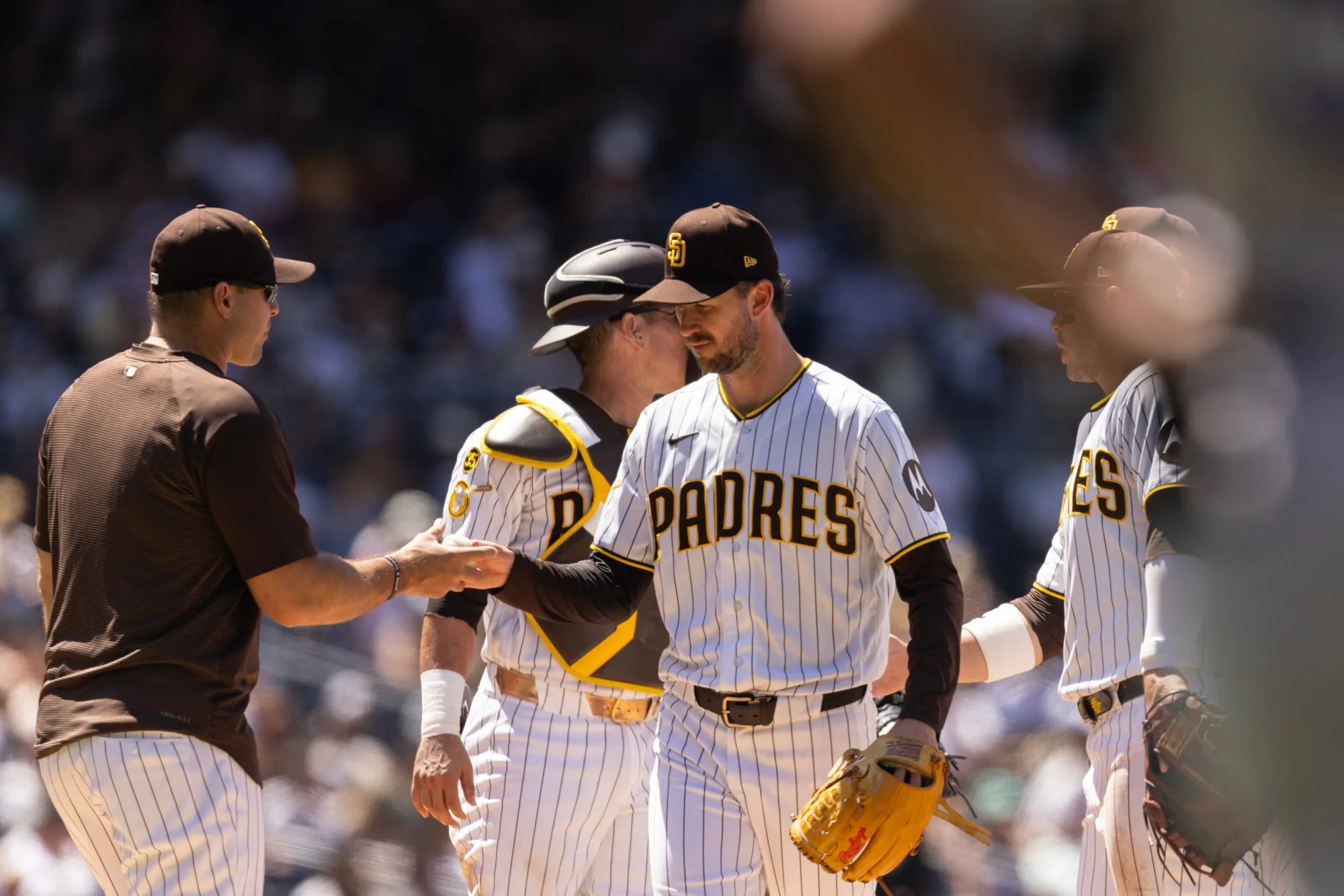
That is when manager Craig Stammen walked to the mound and removed Márquez from the game.
Almost immediately, Padres assistant general manager Josh Stein’s phone began buzzing with texts from people in the organization asking what was wrong with Márquez.
Márquez was fine. Things were just about to get weird.
The Padres were three games under .500 and four games out of playoff position.
Their offense was not hitting at anywhere near the level it was expected to.
But the biggest problem was that the Padres had 1½ reliable starting pitchers.
It was a matter of time before the front office essentially conceded this wasn’t their year and shifted its attention to long-term planning.
That was the reality.
Everyone knew it. Throughout the clubhouse, players were professing confidence and vowing to do everything they could to turn things around in time to make sure a trade-deadline selloff did not happen.
In that they had been saying those things for a while, their chances seemed dubious.
Everyone knew that too. Or at least a small group of decision-makers did.
And so, unbeknownst to almost anyone, a plan to save the season had been concocted just hours before Márquez took the mound.
The Padres were going to lean all in to embrace their lack of starting pitching.
And now …
The Padres are lining up their full complement of starting pitchers for the postseason this week.
Michael King will pitch Tuesday night in the series opener against the Dodgers with the hope he doesn’t need to get on the mound again until Game 1 of the National League Wild Card Series.
Robbie Ray and Nick Pivetta will start the second and third games at Dodger Stadium on Wednesday and Thursday. Walker Buehler and Casey Mize will pitch in some order over the weekend against the Diamondbacks.
This is an actual starting rotation on a team presently given a 97% chance to make the playoffs.
Yes, the offense became what it was always supposed to be around midsummer.
But the Padres stabilized a little more than 100 games into their season and are now probably a couple of games away from clinching a postseason berth because the pitching got better at the beginning of games.
And because it did — in a most unexpected way — the Padres now have a group of starting pitchers that are on most nights setting the team up for victory by getting through the bulk of innings.
This is so far from the reality of most of 2026.
There was a long period of time when the Padres essentially had no starting rotation and seemed doomed because of it.
And then they stepped full-on into an embrace of that circumstance and their season was saved.
Over a span of nine games in late July and the first couple days of August, the Padres implemented a plan so radical and so desperate it was either going to work or the season was going to be lost.
They went 8-1.
The day after that stretch, on Aug. 3, they made trades for Mize and Ray. Pivetta returned five weeks later.
Mize and Ray would not be pitching for the Padres and Pivetta would not be pitching in meaningful games if not for what happened during a heated meeting in a hotel room in Miami.

What wasn’t working
Discussion had been going on internally for months about how to better utilize the available resources on the pitching staff.
The Padres used openers sporadically in May, then even more in June. They were kinda sorta going with bullpen games for a time in July.
But those measures were sporadic.
On many nights, starting pitchers were not only not giving the Padres a chance to win, they were practically losing the game.
Just 13 times in 32 games from June 16 through July 23 did the Padres get five innings or more from their starting pitcher (or the starter who served as a bulk reliever after an opener).
That left the bullpen having to cover an inordinate amount of innings. Relievers who should have been protecting leads were being expended to try to keep deficits where they were. The Padres trailed by the second inning in 10 of those 32 games. In six, that deficit was multiple runs.
Through one lens, manager Craig Stammen and pitching coach Ruben Niebla were doing the best they could with what they had.
Joe Musgrove and Pivetta, the two veterans expected to join King atop the rotation, had been sidelined by elbow injuries early on. Griffin Canning and Márquez, signed during spring training with the hope they could provide depth, had a combined 6.24 ERA. Lucas Giolito, signed in April to provide innings, had provided less than 30 of them and posted a 5.16 ERA before going on the injured list. Randy Vásquez was getting tired. Buehler’s sensational June had given way to an unstable July. King was making every start and grinding through five or six innings.
On July 23 in Atlanta, left-hander Kyle Hart worked a scoreless first inning as an opener before the Padres scored three runs in the top of the second.
Then the right-handed Canning entered the game and allowed a home run on the second pitch he threw to left-handed batter Michael Harris II.
Canning retired the next six batters he faced before switch-hitter Ozzie Albies led off the fourth inning with a home run.
Then, with two on and two out and lefty Yuki Matsui warmed up, Stammen left Canning in to face left-handed-hitting Dominic Smith.
His reasoning would prove crucial to his getting his arms around and committing to what the Padres would the very next day decide to do with their pitching staff.
In his first at-bat against Canning, Smith had grounded a changeup weakly back to the mound. With that in mind — and with that being the Padres’ seventh game in seven days with the next off day four days away — Stammen stuck with Canning.
Smith hit a 1-1 changeup over the wall in right field to give the Braves a lead they would never relinquish.
The Padres fell to 50-53 that day.
That sequence, that loss, so many games in the preceding month — it all prompted a reckoning.

The meeting
On the morning of July 24, before the Padres’ series opener against the Marlins, four men met in a room in a luxury hotel.
Over the course of nearly two hours, they talked and shouted and engaged in an intense give and take about how to best go about salvaging a season that was circling the drain.
The Padres had lost five of their first seven games after the All-Star break.
Members of the front office were working a dual track, preparing to sell off pieces and preparing to acquire help at the trade deadline that was 11 days away.
They didn’t know which direction they would go. But what they did at the deadline would be based on whether the Padres won enough games before then to get more firmly in contention.
And the front office didn’t want to just let that happen.
Padres president of baseball operations A.J. Preller’s desire to talk about potential solutions to challenges again and again from angle after angle is arguably his most indelible attribute.
But, unlike in some organizations, Preller and his lieutenants do not explicitly tell Padres managers how to set lineups or deploy pitchers. Even past managers who have been rankled by Preller’s relentless ideas acknowledge that.
On that day in Miami, however, the time had come for the Padres to make some decisions.
“This isn’t working,” Preller recalled of his thoughts at the time. “We gotta be open to changing it.”
The relationship that had been developed between the men involved over the previous four years is what allowed for constructive dialogue.
“We just had it out,” Stammen said. “We got some yelling going on, some back and forth, but it was, like, very constructive and positive in the end.”
Preller and Stein had proposals they had proffered to varying extents for a while. Niebla had been discussing various ideas with his pitching coaches for months. Stammen advocated for sticking with the traditional rotation and bullpen arrangement as much as they could.
When the four of them met in Preller’s room that Friday morning, it was with the idea that the season was on the brink.
Stammen contended in the meeting that they were already making outside-the-box maneuvers.
Niebla, who had been a pitching coordinator for nearly two decades in the Guardians organization before Preller hired him in October 2021, even before Bob Melvin was hired as manager, had experience supplementing minor-league pitching staffs in creative ways.
Along with bullpen coach Ben Fritz and game planning and pitching strategist Peter Summerville, Niebla had been pulling the strings just to get the staff to that point in the season.
Preller countered that it was not enough.
“We gotta do it to the degree we need to do it to get through this period,” he said. “We gotta take it further.”
And that is what they did.
In that room, the four men hashed out the potential risks and rewards of a profoundly unorthodox approach to getting through games over the next week-and-a-half.
The plan would almost certainly not work longer than that. And they didn’t need it to. This was an effort to win enough games to be able to add starting pitchers at the trade deadline.
It was decided the pitching coaches — with input from Summerville, advance scouts Bill Masse and Mike Borzello and the research and development department — would map out games pitcher by pitcher based on how they matched up against opposing hitters. Each pitcher was going to face the group of hitters he was best suited to face.
That would be it. The idea was to maximize a pitcher’s talent and minimize his exposure.
King and Buehler would be the Padres’ only traditional starting pitchers. Closer Mason Miller and setup man Adrian Morejón would remain in their roles. Everyone else would be ingredients in a highly detailed recipe of pitching jambalaya.
In Preller’s room, they worked through details like how often they would have to have a pitcher warming up in the bullpen. They talked about potential snags such as if one pitcher simply couldn’t get outs. They discussed the potential health risks that could arise from working pitchers in ways they were not accustomed to, how frequently pitchers could bounce back to pitch again and who they had available in Triple-A to possibly be able to supplement the staff.
It was a spirited discussion, right up until Stammen and Niebla had to leave because they needed to get to loanDepot park for that night’s game.
In the course of all that talking, Stammen, the former pitcher who had trouble getting his arms around using his staff in a new way, said to himself: “All right, this is the way we’re gonna do it.”
He recalled later, “I was still like, ‘I don’t know how I’m going to do this, but we’ll go figure it out.’”
As he left, Stammen turned to Preller and said, “I still love you.”
Preller replied, “I love you too, man.”

The buy-in
Stammen arrived at the ballpark a short while later. He convened a meeting with the team’s pitchers and told them about the new plan.
He did not mention Preller’s name. He did not say anything about how he had pushed back. He used “we” and “us” and confidently explained why it would work.
The people who came up with the plan were not entirely convinced it was going to work. So it should not be surprising there was skepticism elsewhere.
“I definitely doubted it,” King said.
But the pitchers involved jumped in. That was especially important for the starters who were no longer starters and still wanted to be starters.
Not that they had a great argument for the status quo.
“Especially if you’re not necessarily getting the results you want to get, it makes it a lot easier to be on board with whatever,” Canning said. “At the same time, I think everyone just wants to win. So if that was what they thought was best, then I think it was easy for all of us to get on board.”
The manner in which Márquez, a former All-Star, bought in made it especially difficult when the team let him go a short while later.
“He was so all in, so for the team,” Stammen said. “He was so for, like, ‘Let’s figure out a way to win; I’ll do anything that you ask.’”
Stammen still sounds a little awed by the collective selflessness.
“We got lucky with the guys we had,” he said. “I think that’s scouting and bringing in high-character people that are more team-oriented. That doesn’t happen. That’s un-normal. I think that’s something we took for granted a little bit. Looking back, I’ve been on teams where those five or six guys wouldn’t have just bought in. And they just bought in.”

The implementation
What the Padres did was commonly referred to as “pitching chaos.”
That was mainly because that was the phrase coined by Detroit Tigers manager A.J. Hinch when his team creatively deployed its injury-depleted pitching staff in the latter half of 2024 and into that postseason when injuries beset the rotation.
But “chaos” is a misnomer. It was meticulously planned.
The research and development department, led by Adam Esquer and Cody Zupnick, along with Summerville, provide reams of information about matchups for each game during the season.
It was how Niebla, Fritz and Stammen used that information that was different in late July.
Stammen and the pitching coaches would meet for a time after each game and vaguely discuss the next day’s plan — who they thought would pitch and when.
Stammen would mull throughout the next day what he thought he wanted to do. Niebla, Fritz and Summerville would meet in the afternoon to flesh out details. Then they would meet with Stammen.
With little variance, Stammen wanted to establish from the start how many batters he was going to leave a pitcher in for.
He thought back to the moment he let Canning face Smith a second time in Atlanta.
“I felt for me, I could do a better job of managing the pitching staff that way if it was more ‘This is how we’re going to do it,’ rather than like feel for the game and guess,” Stammen said. “I called it guessing. — where you’re like just wait and see if (the pitcher) is OK or not.”
There were tiny allowances for flexibility. But the idea was to only keep pitchers in for the prescribed lane — or the period of time when they could get as many favorable matchups as possible and as few unfavorable matchups as possible — and not push it beyond that.
That meant taking guys out when it did not make sense by some traditional norms.
“We were willing to be aggressive even when we were not comfortable with it,” Niebla said.
An example of that was taking out Canning with two out and nobody on in the top of the sixth inning on July 29 when he had allowed just one hit in three scoreless innings. It was time to put in lefty Wandy Peralta to face a left-handed batter.
“Matchups and putting guys in good lanes is what we do on a daily basis,” Niebla said. “We just did it to multiple people per game.”
The Padres could maximize the matchup game better than most because what was now essentially an 11-man bullpen was made up of five lefties and six righties.
The Padres also had the good fortune of facing teams like the Marlins and Giants and Rockies in those nine games. Those teams were not only not very good but possessed lineups with left-handed hitters as their best weapons.
More than anything, Padres pitchers did their jobs.
“It just felt like everybody stepped up,” Niebla said.
The Padres used five relievers after Márquez’s truncated start, won 4-2 on July 24 and won 7-2 the next day when erstwhile starters JP Sears, Matt Waldron and Vásquez covered eight of the nine innings.
Buehler and King started the next two games, both victories, before the Padres turned back to their pitching stew.
“After three or four games,” King said, “I realized there’s actually some wins in this, um, let’s call it a program.”
They would go 5-1 in the games in which they deployed the group.
“We didn’t have a game that bit us when we did it,” Fritz said. “Because one game goes south, it affects the next two.”
The only real hiccup came on Aug. 2, when they brought back Sears on two days’ rest. Clearly tired, he allowed two runs and took 28 pitches to get through his one inning. The Padres ended up beating the Giants 5-4 that day.
And it was mission accomplished anyway.
King was due to start the next day, which was also the day of the trade deadline.
By then, they had saved the sinking ship. They knew what was coming.
“We were at the edge of it,” Niebla said of the plan’s sustainability. “And then A.J. does his job. … That 10 days, it made us better to finish strong. Somehow.”
top stories sdut,latest headlines,mlb,san diego padres,sports
#heated #meeting #games #saved #Padres #season